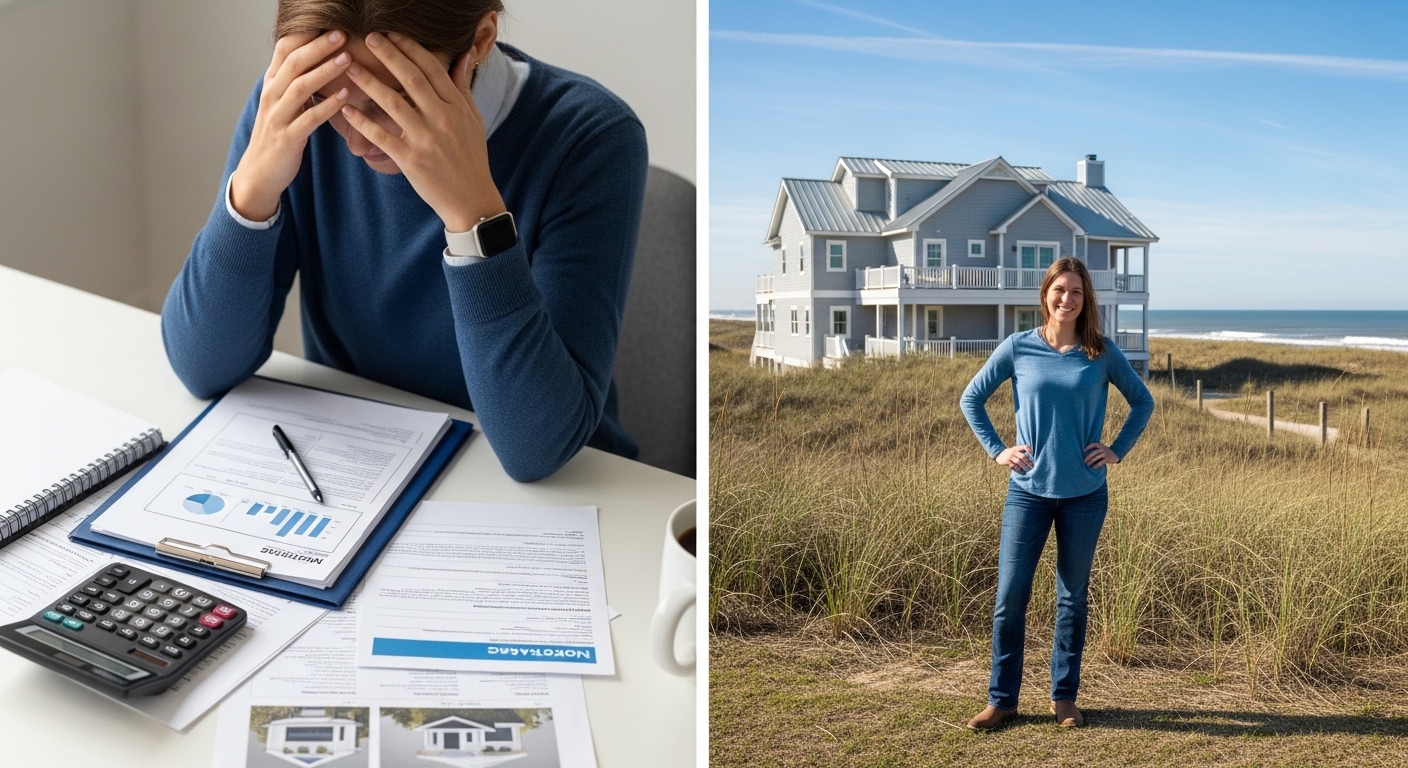
You've spent months scrolling through listings on HOUSEJET, attending open houses along the Outer Banks, and daydreaming about that perfect oceanfront property or cozy cottage in Nags Head. Then it happens: you find the one. The home that checks all your boxes, where you can imagine your life unfolding. Now comes the moment that separates excited buyers from successful ones: determining how much to offer.
This is where strategy matters. The 2026 real estate market looks dramatically different than the frenzied pandemic years, and nowhere is that more evident than in Nags Head. On average, homes in Nags Head sell after 56 days on the market compared to 78 days last year, and the housing market is somewhat competitive. Understanding how to navigate this shift from frenzy to balance is critical to securing your dream home without overpaying.
Understanding the Nags Head Market Right Now
Before you write your offer, you need to know what you're walking into. We're seeing the most balanced market conditions since before the pandemic, with inventory finally rebuilding and bidding wars becoming less common. That's good news for buyers in Nags Head, but it also means the days of winning with a full-price offer are mostly behind us.
Here's what that balance looks like locally: In March 2026, Nags Head home prices were up 50.9% compared to last year, selling for a median price of $1.1M. If you're looking at properties in neighborhoods like The Village at Nags Head, over the three months ending May 2026, home prices were up 2.3% compared to the same period last year, selling for a median price of $644K, with homes selling after 47 days on average. This tells us two things: the market is active, but homes aren't disappearing in 48 hours like they used to.
The Foundation: Know Your Real Budget
Here's the mistake I see most often when working with buyers: they fall in love with a home, then figure out what they can afford. That's backwards. Before you even tour a property seriously, you need to understand your actual financial ceiling, not just what a lender will approve.
Your offer cannot exceed what your lender will finance plus your cash on hand for the down payment, closing costs (typically 2% to 5%), and an earnest money deposit of 1% to 3%. But here's the part that matters even more: Run a mortgage calculator at your locked or quoted rate, including property tax, homeowners insurance, HOA, and PMI if applicable. Many buyers stretch on price without recalculating the monthly, and that's where 'I love this house' turns into 'I can't afford this house' six months in.
Use the 28/36 rule as a guide. Spend no more than 28% of your gross monthly income on housing expenses (your monthly mortgage payment, including property taxes and home insurance) and no more than 36% on housing and all your other debt.
Move Beyond List Price: Study the Comps
One of the biggest lessons I've learned in real estate is this: the asking price is just a starting point. It tells you what the seller hopes to get, not necessarily what the home is worth.
The right offer on a house depends on three things: how the home compares to recent sales nearby, the property's condition, and how quickly homes are selling in that market. What matters more is fair market value, which comes from looking at what similar homes actually sold for in the past few months. Your real estate agent can pull this data, and it gives you a factual basis for your offer rather than guessing.
In Nags Head specifically, comparable sales in your neighborhood paint a much clearer picture than the list price alone. A beachfront home in Kill Devil Hills might fetch a very different price than a soundfront property in the same price range. That's why working with an agent who knows the Outer Banks neighborhood by neighborhood is so valuable.
How Much to Actually Offer
The answer depends entirely on where you're shopping. Moderate competition means some homes get multiple offers while others don't, homes sell within 30-45 days on average, offers around asking price are common, and room for small negotiations exists on most properties.
For homes in a moderate competition situation, offer strategy depends on how much you want the specific property. If it checks all boxes and you can't imagine losing it, offer full price. If you like it but would keep looking if price isn't right, try 2-5 percent below asking and see if seller counters.
In some Nags Head neighborhoods, particularly move-in-ready oceanfront homes or well-maintained cottages on desirable streets, offers typically land 5% to 10% below the asking price in balanced markets. But if the home needs work, your offer can be more aggressive. Major repairs involve structural work, roof replacement, outdated electrical or plumbing, or HVAC systems at end of life. Projects like this can cost tens of thousands of dollars and take months to complete. Offers 15% to 25% below asking are typical, though having contractor estimates helps support your number.
Read the Market Signals
Not all properties are created equal in terms of negotiation room. If the house has been on the market for several months or more, the owner may be more motivated to sell. This could give you more room for negotiating the price down, especially if it's been reduced before.
In Nags Head, where the real estate market moves faster than it did in 2024 and 2025, a home sitting for 60+ days is worth investigating. National median days on market is 55. A listing under that line is still fresh enough that the seller can wait. A listing that crosses 60 days has a problem the seller has not solved. It could be price, it could be condition, or it could be that the home simply needs the right buyer with the right offer terms.
Strengthening Your Offer Beyond Price
Here's something that surprises many buyers: price isn't the only thing sellers care about. In a balanced market, two offers at the same dollar amount are rarely equal. Make sure you have a good agent who can explain the benefits of your offer beyond just the price.
What makes an offer stronger when price is similar? Think about making your offer stronger by putting down more earnest money, shortening the time frame for contingencies, and being flexible about the closing date. The standard is 1%-3% of the purchase price, but bumping this to 5% or higher in a competitive situation signals serious intent and commitment.
By 2026, a standard pre-approval letter is merely table stakes. To truly stand out, you need Verified Approval. Unlike a basic pre-approval, this means your lender has already fully underwritten your credit, income, and assets before you even tour a home. This signals to the seller that financing contingencies are virtually certain.
The Escalation Clause Strategy
If you're in a competitive situation in Nags Head (which still happens on premium properties), an escalation clause can be your secret weapon. You might submit an offer to buy a home for $500,000 with an escalation clause that increases your bid in $1,000 increments to a maximum of $550,000. If no one offers more than $500,000, you can buy the property for $500,000. If someone offers $510,000, your bid would automatically go up to $511,000. If someone offers more than $550,000, you're losing out on the home but won't have paid more than you can afford.
However, a drawback of escalation clauses is that they show the seller the maximum you're willing to pay, which limits your negotiating strength. Use them strategically, not as your default.
Know When to Walk Away
This might be the most important part of the entire process. Decide your walk-away number before you write the offer. Sellers can sense buyers who haven't set a ceiling, and the negotiation rarely goes well from there.
You loved the oceanfront cottage. You can see yourself on the deck at sunset. But if that home would stretch you beyond your financial comfort or your actual budget, walking away is the smart move. There will be other homes in Nags Head. There's only one of your financial security.
The Role of Your Local Real Estate Expert
I can tell you this with confidence after years of helping buyers in Nags Head: Your real estate agent has been through this dozens or hundreds of times in your specific market. Their advice is invaluable. Good agents understand recent offer patterns in the neighborhood, pricing strategies of different listing agents, seller motivation based on circumstances, upcoming listings that might reduce urgency, and neighborhood dynamics affecting desirability.
When you're working with me to buy in Nags Head, I'm not just pulling comps from a database. I know these neighborhoods. I understand which properties are attracting out-of-state buyers and which are appealing to locals. I know the listing agents, the motivated sellers, and the market trends in each area from Kill Devil Hills to The Village at Nags Head. That knowledge translates directly into a stronger offer that actually gets accepted.
Putting It All Together
Crafting an offer on your Nags Head dream home is part science, part strategy. Start with your budget, anchor to the comps, understand your market, and then decide how much to offer based on condition, competition, and your emotional attachment to the property. Make your offer strong with earnest money and terms that matter to the seller. Know your walk-away number. And never hesitate to reach out for expert guidance.
The balanced market we're seeing in 2026 is actually in your favor as a buyer. Yes, it means less room for aggressive lowball offers, but it also means homes aren't disappearing in bidding wars. It's a market that rewards strategy and preparation, not panic and emotion.
When you're ready to move from looking to offering, I'm here to help you navigate every step. Whether you're searching for a beachfront property, a cozy cottage in town, or something in between, let's craft an offer that gets your home and protects your financial future. Visit my website at https://obxconley.housejet.com to start your search or reach out to discuss your Nags Head buying goals.